In July a San Francisco renter found a 2-bedroom in Duboce Triangle online, went to the open house, toured the real apartment, signed a lease and wired $18,600. Nobody showed up with the keys. The ad they answered was a copy of the real listing with the contact details swapped. The San Francisco Standard told the story in August, and in October the same scammer nearly took a nurse moving here for a job at UCSF. The Board of Supervisors holds a hearing on rental scams Thursday, Nov 12.
I sell homes and don't handle rentals, but real estate scams are often built from syndicated listing feeds, which I know something about. Here's how the scam works and how to protect yourself.
Data Feeds Publish Details, Social Media Finds Victims
A real estate listing is entered once in the MLS and shared everywhere by data feeds and syndication to brokerage sites, the national portals, search engines and apps.
Rental listings spread the same way, through property-management software and rental sites. A listing feed carries everything that's been entered, which typically includes professional photos, a floor plan, the price, the open house times and a contact name.
Nobody has to hack anything. The FTC describes the standard method: copy a real listing, change the contact information, post it somewhere else.
The FTC counted nearly 65,000 rental scam reports and about $65 million in losses from 2020 through mid-2025, and says most fraud is never reported. Many of the copied ads were for homes that were for sale, not for rent. A staged, vacant home with published open house hours is easy to pass off as a rental, and neither the seller nor the listing agent is looking for it as a rental.
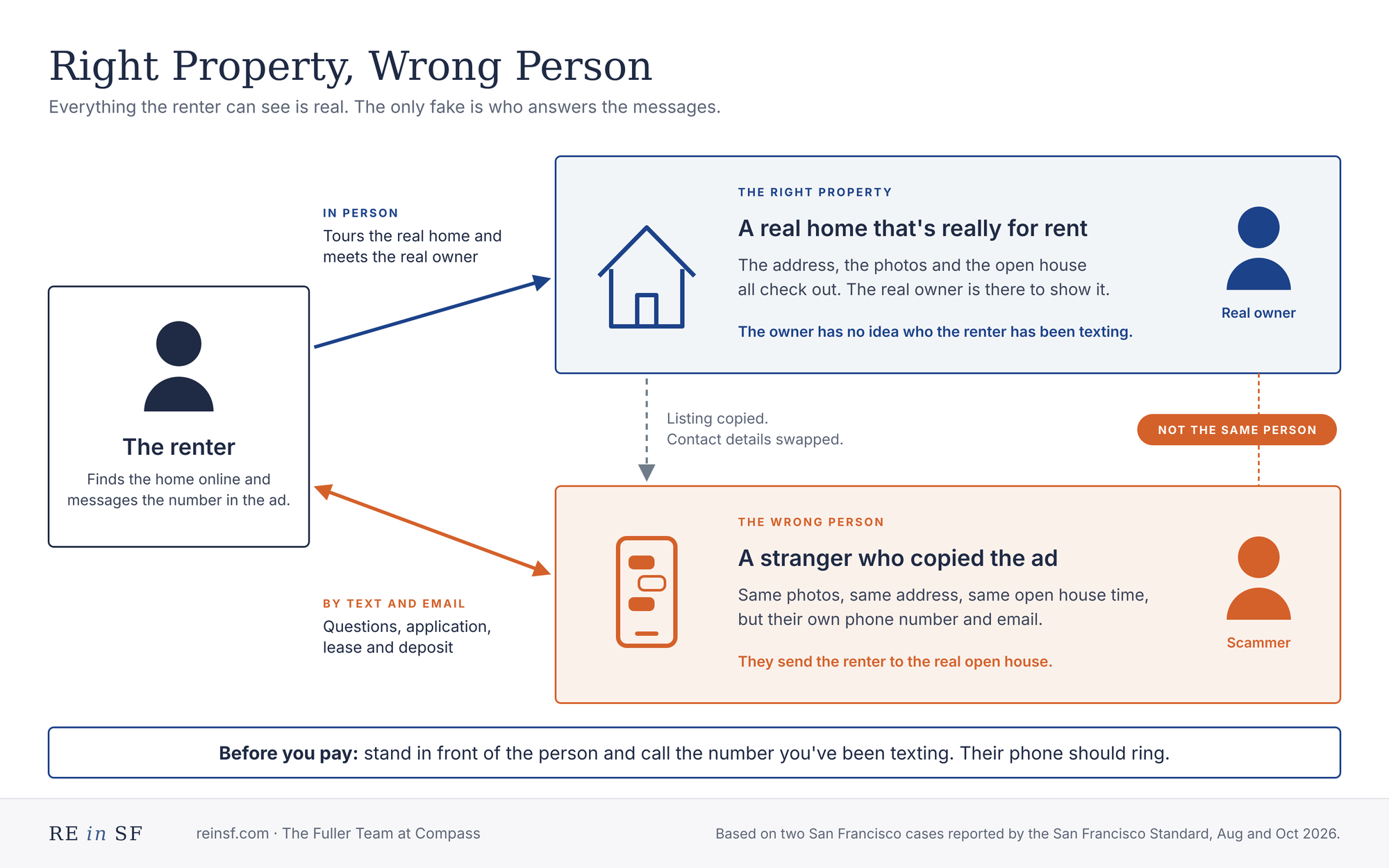
The scam works because everything in the fake cloned listing checks out:
- The address is real
- The photos match
- The open house is a real open house
The only false detail is who's on the other end of the message. That's why touring the place no longer proves anything: both San Francisco renters met the real owner at the real property while paying, or nearly paying, someone else.
Social Media Supercharges All of It
About half of the people who reported a rental scam in the FTC's latest year said it started with an ad on Facebook, and 16% said Craigslist. Anyone with an account can post a home they don't own.
Scammers fake being the agent too: the California Department of Real Estate warned in April that real licensees' names, photos and license numbers are being used on fake social accounts, and SFGATE found San Francisco agents whose apartment-tour videos were reposted by scam accounts at different rents.
AI makes every piece cheaper: the profile, the lease and a landlord who texts back in seconds.
Enforcement won't save you. The Standard reports that the SF police fraud team is 2 people who also pull parade duty when needed. A fake Craigslist ad stayed up for days after the owner reported it, and Facebook is notorious for hands-off moderation.
StopScams SF, which the treasurer's office launched in July, is an unusual and useful thing for a city to offer: a clearinghouse for information, with counselors who help victims report. For now it can advise, not act.
The Three Verifications
Every version of this scam depends on the victim using contact details the scammer supplied. Proactively verifying the person you are messaging is the authorized agent or owner is the step that shuts down this scam.
1. Verify the Property
- Search the address. If the same home shows up with a different contact or a different price, or is listed for sale and not for rent, stop. Sometimes a home can be listed for sale and rent, but verify, verify, verify.
- Find the original listing. A home listed by an agent or a management company will be on that company's own website. If it isn't, ask them why.
- Check the rent against similar places nearby. A price well under the market is a red flag.
- Go see it. A tour proves the home exists and is available. It doesn't prove who you're dealing with, so keep going.
2. Verify the Owner or Authorized Agent
- An agent or property manager: ask for their name and DRE license number, look them up on the DRE's license search, then call the brokerage's main line at a number you found yourself. Ask whether this person works there and has this listing. That's the DRE's own advice.
- A private landlord: ask for ID and check it against the owner of record. San Francisco has no simple online owner lookup. The do-it-yourself route is the Assessor-Recorder's recorded-documents search, which is free but takes an account, the parcel number and some patience.
- Many San Francisco homes are held in a trust or an LLC, so the names may not match. A real owner can show you a property tax bill or an insurance statement that ties them to the address, and won't mind being asked. In the October case, the real landlord offered to show his driver's license.
- A "verified" badge on a listing site covers the account that posted there. It says nothing about the person texting you from a copy of the ad on another site.
- If you're the owner or the agent: search your own address, name and license number while the listing is live. Report copies to the site, and impersonators to the DRE.
3. Verify Who You're Messaging
This may sound stupid, but it's this assumption that makes the scam work. Both San Francisco renters met the real owner at the real property and assumed he was the person they'd been texting.
- Compare the phone number and email you've been using with the ones on the original listing, digit by digit. In the October case the scammer used two nearly identical phone numbers, one to pose as the landlord and one to pose as the renter.
- At the showing, ask the person in front of you, "Are you the one I've been texting?" Then call that number while you're standing there. Their phone should ring.
- Search the phone number and the email address. The nurse did, and found the Standard's August story about the same scammer.
- Notice when you're moved to a different website, portal, or messaging app. The real landlord took applications only through the listing site. The scammer asked her to email hers instead.
- Before any money moves, confirm the amount, the payee and the account with the person you've verified, face to face or at a number you found yourself. The payee's name should match the owner or the management company. The July deposit went to an account in a company name the renter had never seen.
Be Wary of Any Changes
Bank payment systems rarely fail, and bank account numbers almost never change. Any change to an agreed-upon plan is a massive red flag. Sometimes life happens and things change, but last-minute bank account changes are a movie plot line, not real life.
"Try this other account" is almost always a scam, however reasonable the excuse. The July renter was told the bank was having a network error. He called the bank, and it was. He sent the money to the second account anyway, and that was the loss.
The same rule covers buying or selling a home. Wire instructions get set with escrow by phone, at a number you already have, and an email that changes them is fraud until proven otherwise. There's more on wire fraud and forged deeds in Stop Scams Sooner.
If It Happens to You
- Call your bank immediately.
- File a report at ic3.gov and ReportFraud.ftc.gov. Last year the FBI's recovery team froze $679 million of $1.16 billion in attempted thefts, and immediate reporting made a difference.
- Contact StopScams SF if you are a San Francisco resident.
If something about a listing, a landlord or a wire looks off, stop and don't proceed until you can verify the situation to your satisfaction.