As I prepare to vote in the 2026 election, I asked myself, "Where does all the housing money I've been voting for go to?"
It's a fair question, and the answer is scattered across two decades of voter guides, Controller reports and bond disclosures. So this is an attempt at pulling together everything that I - and likely you - have voted for since 2000.
Since 2000, California and San Francisco voters have approved nearly $18 billion for housing through bonds, taxes and budget set-asides. Most of it has already been handed out. Some of it is still moving. A surprising amount never arrived at all.
Here's the tally. If we got something wrong, missed it or you have other comments, please reach out and let us know!
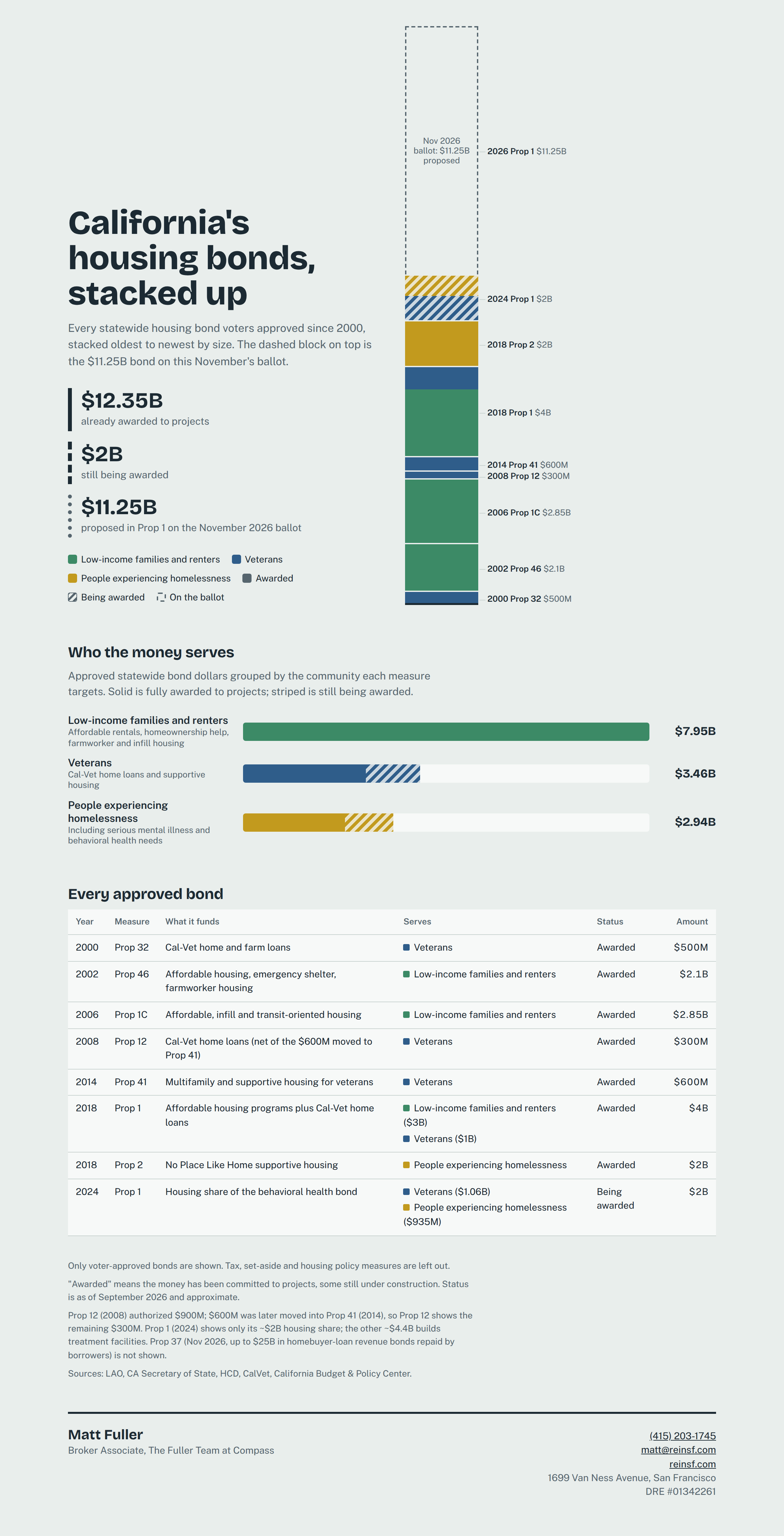
The state: $14.35 billion in housing bonds
Statewide, voters have approved eight housing bond measures since 2000. Counting only the housing dollars, and not double-counting the $600 million that was moved from a 2008 veterans bond into a 2014 one, that comes to $14.35 billion.
About $12.35 billion of that has been fully awarded to projects. The remaining $2 billion, from 2024's Prop 1, is still going out.
Who it serves:
- Low-income families and renters, $7.95 billion. This is the largest share: Props 46 (2002), 1C (2006) and the bulk of Prop 1 (2018).
- Veterans, $3.46 billion. Veterans have a remarkable record at the ballot box. Every veterans housing bond since 2000 has passed, most by wide margins.
- People experiencing homelessness, including those with serious mental illness, $2.94 billion. This comes from No Place Like Home (2018) and part of 2024's Prop 1.
The pattern at the state level has been consistent. Californians will borrow for housing, but they won't expand rent control. They rejected it in 2018 (40.6% yes), 2020 (about 40%) and 2024 (38.4%)*. In 2024 they also declined, at 45%, to lower the threshold for local housing bonds from two-thirds to 55%.
*AB1482 (The Tenant Protection Act of 2019) in effect since January of 2020 did create state-wide rent control laws for most unit buildings 15 years or older.
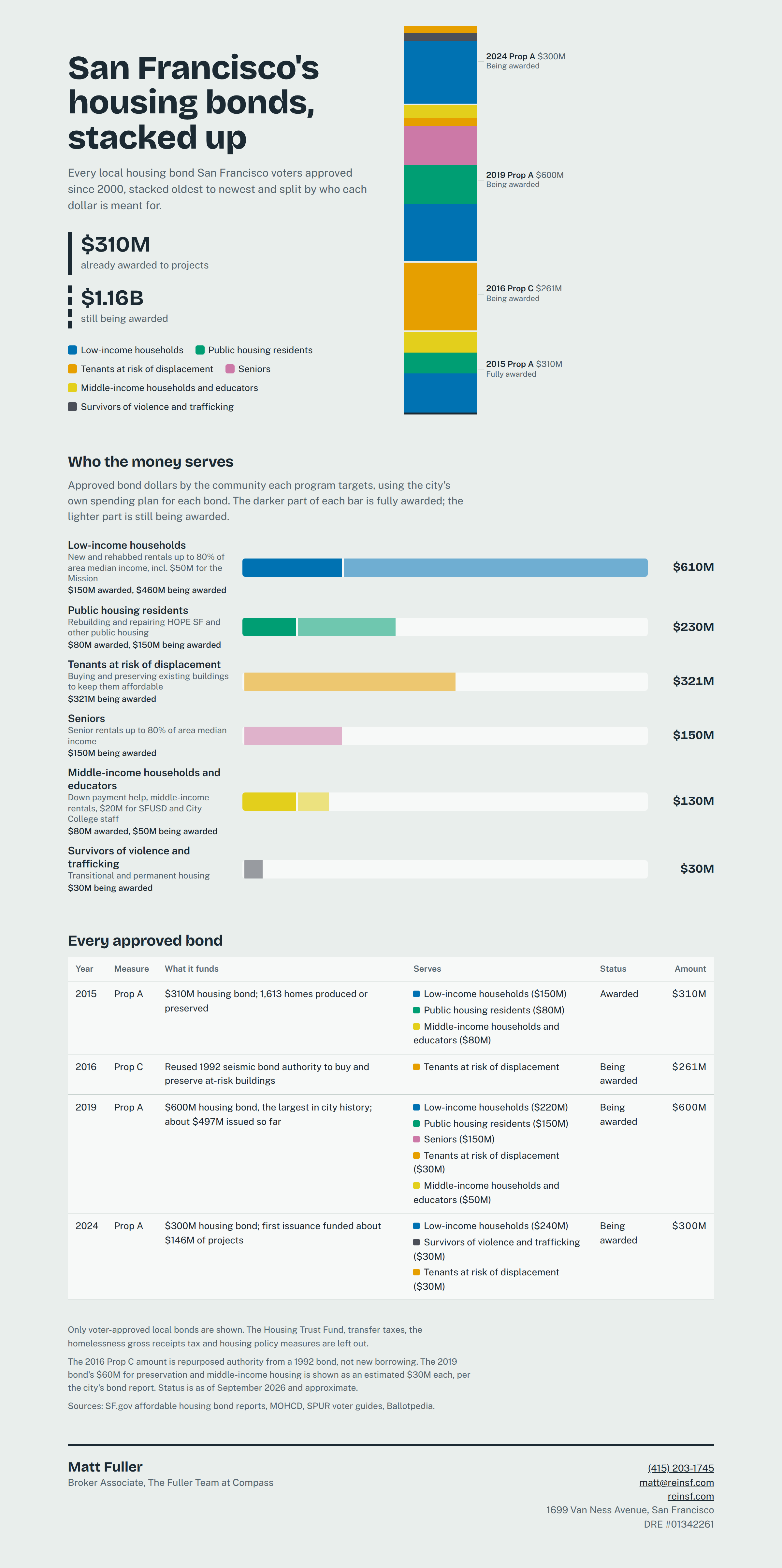
San Francisco: $1.47 billion in local bonds
San Francisco's bond history has a slow start. The city put $250 million and $200 million housing bonds on the ballot in 2002 and 2004. They won 57% and 64% of the vote. Local bonds need two-thirds, so both failed.
The next bond didn't come until 2015. Since then, San Francisco has approved four:
- 2015 Prop A, $310 million: fully awarded, producing or preserving 1,613 homes.
- 2016 Prop C, $261 million: unused authority from a 1992 seismic bond, redirected to buying and preserving at-risk buildings.
- 2019 Prop A, $600 million: the largest housing bond in city history. About $497 million has been issued so far.
- 2024 Prop A, $300 million: still early in its spending.
Where the money goes, by the city's own spending plans:
- Low-income households: $610 million
- Tenants at risk of displacement (buying and preserving existing buildings): $321 million
- Public housing: $230 million
- Seniors: $150 million
- Middle-income households and educators: $130 million, including $20 million for SFUSD and City College staff
- Survivors of violence and trafficking: $30 million
San Francisco: the money that isn't bonds
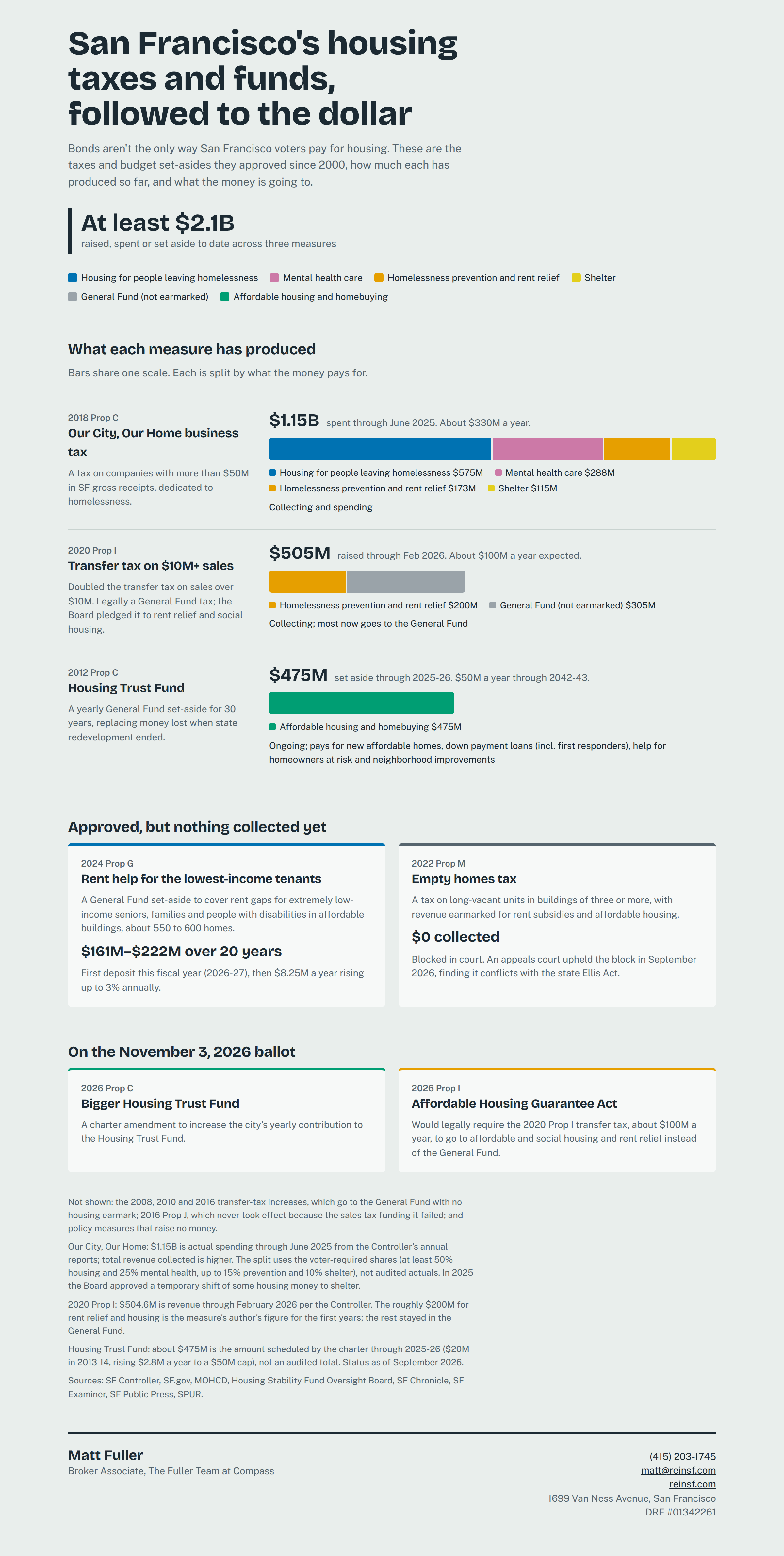
Bonds get the headlines, but taxes and set-asides quietly carry more of the load. Three measures have produced at least $2.1 billion.
Our City, Our Home (2018 Prop C). This tax on companies with more than $50 million in local gross receipts has spent about $1.15 billion through June 2025, and it now brings in around $330 million a year. Voters required at least half to go to housing for people leaving homelessness, at least a quarter to mental health, and the rest to prevention and shelter. In 2025 the Board approved a temporary shift of some of the housing money to shelter.
The 2020 transfer tax (Prop I). This doubled the transfer tax on sales over $10 million, to 5.5% and 6%. It has raised $504.6 million through February 2026. It was sold to voters as money for rent relief and social housing, and the Board passed a resolution saying so. Legally, though, it's a General Fund tax. By its author's count, more than $200 million went to housing and rent relief in the first years; most has gone to the General Fund since.
The Housing Trust Fund (2012 Prop C). This is a 30-year set-aside created after the state eliminated redevelopment agencies. It started at $20 million a year and rises to about $50 million. It has set aside roughly $475 million so far, for new affordable homes, down payment loans (including for first responders), help for homeowners at risk, and neighborhood improvements.
Two more measures passed but haven't produced a dollar yet. 2024's Prop G (rent help for extremely low-income seniors, families and people with disabilities) makes its first deposit this fiscal year. 2022's Prop M (the empty homes tax) is blocked: an appeals court ruled this month that it conflicts with the state Ellis Act.
What's on the ballot November 3, 2026?
Statewide:
- Prop 1 is an $11.25 billion housing bond, nearly as much as every state housing bond approved since 2000 combined. Supporters say key state programs have run out of money. Opponents point to the debt it adds.
- Prop 37 would create up to $25 billion in revenue bonds for middle-income homebuyer loans, repaid by the borrowers.
- Prop 45 would change environmental review for housing and infrastructure projects.
In San Francisco:
- Prop C would increase the city's contribution to the Housing Trust Fund.
- Prop I, the Affordable Housing Guarantee Act, would legally require the 2020 transfer tax to go to affordable and social housing and rent relief. Supporters say it enforces what voters were promised in 2020. Mayor Lurie has called it a "slush fund" and argues it would take money from other city services.
Why this matters if you own, buy or sell here
These measures don't just fund the affordable-housing pipeline. Most of them show up somewhere in your own numbers.
Your property tax bill. Local housing bonds are repaid through property taxes. For 2024's $300 million bond, the Controller estimated the cost at up to about $55 a year on a home assessed at $700,000. It's modest on its own, but it stacks with every other bond on your bill. If you're a landlord, San Francisco's Rent Ordinance lets you pass 50% of that bond cost through to tenants in covered units.
Your closing statement. At the top of the market, the transfer tax is one of the biggest line items at closing, and in San Francisco the seller typically pays it. Since 2020's Prop I, sales from $10 million to $25 million pay 5.5%, and sales above $25 million pay 6%. On a $25 million sale, that's about $1.375 million, roughly double the $687,000 it would have been before.
Your rents and your returns. Statewide, the Tenant Protection Act caps most rent increases on buildings more than 15 years old. For San Francisco, the cap is 8.8% through July 2027. The city's own Rent Ordinance is far stricter for older buildings. Voters have rejected expanding local rent control three times, so newer construction remains exempt from local caps. There's a real difference in how a 1970s building and a 2015 building pencil out for an investor.
Your vacant units. The empty homes tax (2022's Prop M) is dead after this month's appeals court ruling.
Your heirs and your next move. Prop 19 (2020) is technically a tax measure, but it changed who keeps a low property tax base. Owners 55 and over gained more freedom to take their tax base with them when they move. Heirs lost most of theirs unless they move into the home. If an inherited property or a downsizing move is in your future, plan it around Prop 19, not the rules you remember.
Questions about how any of this affects a property you own or are considering? Reach us at (415) 416-4699 or fullerteam@compass.com.
Figures are as of September 2026 and compiled from the SF Controller, SF.gov and MOHCD bond reports, the LAO, the California Secretary of State, HCD, and reporting from the SF Chronicle, SF Examiner, SF Standard and SF Public Press. The Our City, Our Home split uses the voter-required shares, not audited spending. The Housing Trust Fund total is the charter schedule, not an audited figure.